Historic Mini Globe Race: 24,000 Miles in Globe 580s
Alexandra
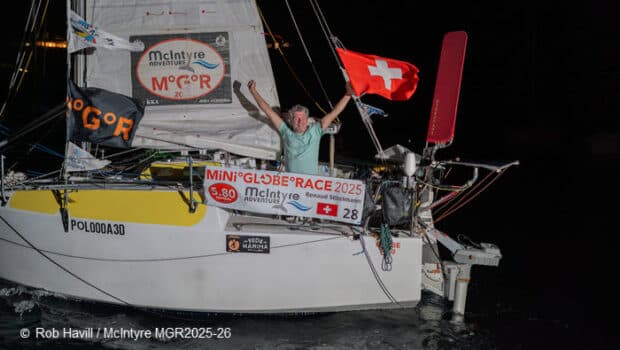
Thirteen men and two women completed a 24,000-mile solo circumnavigation in 19-foot Globe 580 yachts, arriving back in Antigua after sequential legs that called at 15 ports across 13 countries over 13 months.
Race climax and logistics at the finish
Renaud Stitelmann (SUI) recorded the overall benchmark time of 180 days 11 hours 25 minutes 57 seconds, averaging 5.54 knots (approximately 133 miles per day) under varied ocean conditions. The fleet launched from Antigua and followed a multi-stage routing that required shore stops for provisioning, repairs limited to class rules, and medical checks. Organizers tracked positions via an online tracker and managed crew retirements and safety evacuations in cooperation with local maritime authorities at several ports of call.
Key finish statistics
| Statistic | Value |
|---|---|
| Total distance sailed | 24,000 miles |
| Boat type | Globe 580 (19-foot) |
| Entrants | 15 starters (13 men, 2 women) |
| Finishers | 11 |
| Retirements | 4 (3 financial, 1 health) |
| Winner | Renaud Stitelmann (SUI) |
| Average speed (winner) | 5.54 knots |
Boat performance and durability
Despite frequent knockdowns reported across the fleet, the one-design Globe 580 showed no structural failures, rudder losses, or keel damage during the race. This operational resilience underlines the class rules’ emphasis on simple, robust systems and minimal on-board complexity — factors that aided emergency handling and reduced reliance on specialist shore support. The event logistics favored boats that could be repaired with basic tools and locally available materials at small marinas and harbors.
📚 Vous aimerez peut-être aussi
Race concept, organization and class development
The Mini Globe Race (MGR) was developed as a budget-friendly, small-boat solo circumnavigation platform built around the Globe 580 one-design. Construction plans start from euro 350, enabling a broad international builder network. The race founder, together with Polish yacht designer Janusz Maderski, promoted a concept of "SMALL BOAT – HUGE ADVENTURE," emphasizing affordability, universality of construction techniques, and the ability to maintain boats in remote ports.
Administration and support framework
Event administration implemented a Notice of Race with clearly defined retirement and safety protocols. Organizers coordinated with coastal authorities and port agents to provide predictable resupply windows. The multi-leg format required skippers to manage customs, visas and local regulations in each port — logistical complexity that favored sailors with prior experience in singlehanded offshore cruising and good planning skills.
Retirements and logistical constraints
Four entrants retired: three Australians withdrew due to insufficient funds to continue departures from Australia, and one sailor left for health reasons. These cases highlighted the financial and medical contingencies that long offshore events impose, including the ability to re-provision internationally, afford repositioning passages, and secure emergency medical evacuations when necessary.
Historical roots and precedent
The MGR concept echoes the pioneering voyage of John Guzzwell, who in 1955 launched in his 20-foot timber yacht TREKKA and completed the first recorded solo circumnavigation three years later. Guzzwell’s voyage established the practical precedent for small-boat ocean voyaging and inspired successive generations of solo sailors who favored modestly sized, easily repaired craft. Guzzwell’s passing in 2024 at age 94 renewed interest in small-boat bluewater exploration and added symbolic weight to the MGR’s inaugural edition.
Design lineage and one-design rationale
The partnership between the MGR founder and Janusz Maderski produced the Globe 580 as a deliberate evolution of small-boat ocean capability: a compact hull form optimized for self-righting stability, simple rigging, and straightforward systems suitable for global maintenance. The one-design approach reduces costs, levels competitive performance, and simplifies spare parts and repair protocols across diverse marinas and boatyards.
Implications for marinas, coastal tourism and charter markets
The MGR’s operational model — small, easily maintained yachts calling at multiple small ports — has implications for marinas and the coastal tourism supply chain. Smaller vessels can make use of tighter berth spaces and simpler shore services, increasing demand at local marinas in secondary destinations. For charter operators and boat-rental businesses, the event highlights a potential market for affordable adventure charters or training programs in singlehanded seamanship.
- Marina demand: Increased transient calls from small-boat adventurers can boost local revenue without requiring large superyacht infrastructure.
- Boatyard services: Local yards may see new business in hull repairs, basic rigging work, and refitting for Globe 580-style craft.
- Training and certification: Growth in interest for singlehanded sailing could create demand for skipper training, safety courses, and short-term charters to practice offshore techniques.
Second edition and forward planning
Organizers have already announced a 2029 second edition, with over 25 sailors tentatively committed. The growth in builder activity — with active Globe 580 builders in 37 countries — suggests that the class could expand rapidly, creating a network effect of spare parts availability, shared knowledge, and informal support across ports.
Forecast for international tourism and yachting activities
If the class continues to grow, expect modest but tangible impacts on coastal destinations: increased visits by adventurous sailors, more local spending in marinas and anchorages, and expanded interest in affordable long-range cruising. For tour operators and charter managers, there is opportunity to offer preparatory voyages, provision packages, and re-supply services targeted at small-boat circumnavigators and training crews.
Practical takeaways for sailors and charter operators
Key lessons from the inaugural MGR:
- Robust, simple design and accessible construction plans reduce the barrier to entry for long-distance sailing.
- Financial planning is as crucial as seamanship — three retirements were directly linked to funding shortfalls.
- Local port infrastructure that can service small yachts with basic repairs and provisioning enhances route viability.
For charter businesses contemplating a role in adventure sailing, offering specialized packages — from skipper training to provisioning and medical evacuation insurance — could become a value-added service aligned with this emerging niche.
The inaugural Mini Globe Race proved that a well-defined one-design small yacht class can safely and sustainably support solo circumnavigation while remaining affordable and accessible. It connected historic precedent from John Guzzwell’s TREKKA to a modern, distributed builder network and demonstrated practical logistics for multi-port race support. As the Globe 580 fleet expands and the 2029 edition approaches, expect the event to influence local marinas, yachting activities, and the charter sector by inspiring new itineraries, training programs, and shore-side services.
GetBoat service (GetBoat.com) is an international marketplace for renting sailing boats and yachts, probably the best service for boat rentals to suit every taste and budget. Whether you’re interested in a small yacht for singlehanded practice, a charter for coastal cruising, or larger superyacht experiences, GetBoat helps connect skippers, captains and charterers to destinations, marinas and activities — from lake and gulf trips to sea and ocean passages, fishing days, and clearwater beach escapes. This summary wraps up the main points: the MGR’s 24,000-mile course, the Globe 580’s durability and affordability, the race’s logistical lessons, and its potential to spur demand in yacht charter, boat rent, marinas, and broader yachting and boating activities.


