New International Standard Measures Superyacht Impact
Alexandra
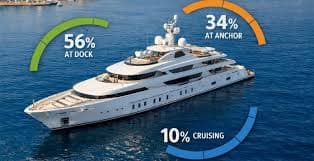
ISO formally approved ISO/TS 23099 for yachts longer than 98 feet (30 meters), basing its calculations on an operational profile of 10% cruising, 34% at anchor and 56% docked — a profile that drives new metrics for onboard energy use, emissions and onboard systems performance.
What ISO/TS 23099 establishes for large yachts
The specification creates a science-based, comparable method to assess the environmental performance of superyachts. Rather than relying solely on fuel consumption or CO2 outputs, the standard uses a composite score called EcoPoints, which integrates multiple impact streams including nitrogen oxides (NOx), particulate matter and lifecycle considerations for onboard systems. Scores are normalized across gross-tonnage bands so vessels of similar size can be compared objectively.
Key components of the new specification
- Operational profile: a median usage pattern derived from statistical research — cruising (10%), at anchor (34%), docked (56%).
- EcoPoints: aggregated scoring that weights CO2 alongside NOx and other environmental factors.
- Comparative scoring: performance is reported relative to yachts within the same gross-tonnage category.
- Applicability: intended for large yachts (>98 ft / 30 m) including new builds and refits.
Practical implications for yards and owners
Shipyards and designers can use the standard as a technical benchmark when specifying propulsion, energy storage, and hotel systems. Owners can use the score to compare vessels for charter potential, resale value and long-term operating costs. For refit projects, the EcoPoints approach enables scenario modelling to forecast how different interventions — such as hybrid propulsion, battery capacity upgrades or scrubbers — will affect overall environmental performance.
📚 Vous aimerez peut-être aussi
How the standard was developed
The specification evolved from the Yacht Environmental Transparency Index (YETI), an initiative led by the Water Revolution Foundation. The ISO working group, convened by Robert van Tol, compiled operational data from megayachts and performed statistical analysis to derive the median profile used in scoring. Technical leadership from Hanna Dabrowska at Water Revolution Foundation and environmental input from Awwal Idris helped expand the scope beyond CO2 to include a broader set of pollutants and operational impacts.
Why a yacht-specific standard matters
Commercial shipping regulations typically assume vessels spend the majority of time underway. Yachts, by contrast, are stationary far more often — at anchor or docked — which affects fuel consumption patterns, auxiliary power demands and local air and water quality impacts in marinas and anchorages. The ISO/TS 23099 specification therefore provides a tailored metric that reflects real-world yachting behaviour rather than repurposing merchant-vessel rules.
Operational profile and environmental trade-offs
| Operational Mode | Median Share | Primary Environmental Concern |
|---|---|---|
| Cruising | 10% | Fuel combustion CO2, NOx |
| At anchor | 34% | Auxiliary power emissions, discharge risk |
| Docked | 56% | Shore power use, local air quality |
The table highlights where designers must prioritize interventions: reducing underway emissions for cruising segments, minimizing generator runtime and improving wastewater handling for at-anchor periods, and maximizing shore-power integration for docked operation.
Steps yards and owners should consider now
- Measure baseline EcoPoints for existing vessels to identify major contributors to the score.
- Model refit scenarios (e.g., hybrid drive, battery buffers, advanced wastewater treatment) to compare EcoPoint reductions per investment dollar.
- Engage classification societies early to align build standards and certification processes with the ISO specification.
- Promote transparent reporting of EcoPoints in sales and charter documentation to demonstrate environmental performance to buyers and charterers.
Historical context and evolution
Environmental benchmarking in yachting grew from voluntary transparency initiatives. YETI introduced consistent data collection and scoring within the sector, catalysing the push for an internationally approved standard. The ISO process formalised that approach, bringing cross-industry experts together to create a replicable methodology. Historically, yachting lagged behind merchant shipping in standardised environmental reporting because of its diverse vessel types and operational unpredictability; ISO/TS 23099 closes that gap by anchoring assessments to an empirically derived operational median.
Past milestones that led here
- Early voluntary environmental indices and owner-led sustainability pledges.
- Water Revolution Foundation’s YETI — the practical pilot for yacht-focused metrics.
- Industry recognition that one-size-fits-all shipping rules were ill-suited for recreational vessels.
Outlook for the superyacht sector and maritime tourism
Adoption of ISO/TS 23099 is likely to shape design priorities, marina infrastructure and charter market expectations. Marinas may accelerate shore-power and wastewater reception upgrades to help visiting yachts improve their EcoPoints. Charter operators and captains will increasingly market environmental performance as a selling point to eco-conscious clients. Over time, the standard can influence resale valuations and the economics of refits versus new builds by making environmental performance a transparent attribute in the marketplace.
Regulatory uptake remains a separate path: where national or regional authorities have limited yachting-specific rules, ISO/TS 23099 provides a voluntary but robust framework that can be referenced in policy development. The specification also promotes cross-industry collaboration among designers, shipyards, equipment suppliers and environmental NGOs to develop practical, cost-effective decarbonization pathways for large yachts.
In summary, ISO/TS 23099 introduces a tailored, data-driven method for assessing the environmental footprint of superyachts, shifting the sector toward measurable, comparable outcomes. Its emphasis on an operationally realistic profile and composite EcoPoints metric enables owners, yards and marinas to prioritise upgrades with the most impact.
The new ISO standard is significant for the world of yachting, charter and boating: it will inform yacht design choices, refit strategies and marina investments, and will be visible to those booking a yacht or considering a long-term purchase. For travellers and charter clients, improved transparency means better- informed choices when renting a boat, selecting captains and planning activities in clearwater bays, gulfs and ocean destinations. Ultimately, the standard supports a future where superyacht operation coexists with healthier seas, beaches and coastal communities.
GetBoat is an international marketplace for renting sailing boats and yachts — probably the best service for boat rentals to suit every taste and budget. As ISO/TS 23099 drives more transparent reporting of environmental performance, metrics like EcoPoints will become part of how yachts are presented for charter, influencing decisions about which yacht to rent for beach or lake excursions, fishing trips, or luxury superyacht experiences. Whether searching for a captained charter, a bareboat option or a sale/refit prospect, potential clients and owners can use these new measures to compare performance across marinas, destinations and vessel types. For ongoing updates on how this standard reshapes yachting, destinations and boating activities, explore more on GetBoat.com.


