One-on-Two Opti Training at Coyote Point Yacht Club
Alexandra
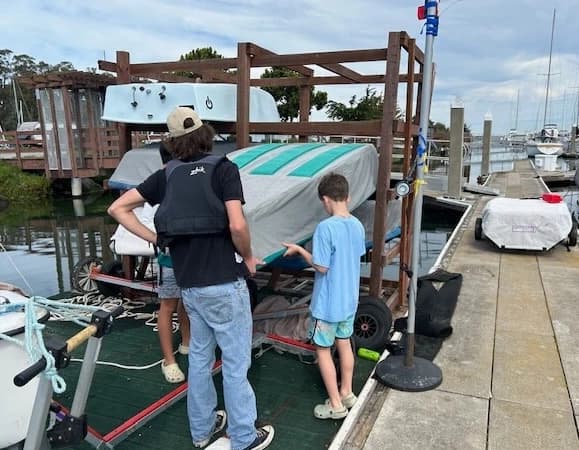
The Coyote Point Yacht Club stores its Optimist prams on high-capacity racks adjacent to the docks, with centerboards and rudders staged for rapid rigging and two-wheeled launch carts used to move boats across the marina apron to the slip.
On-the-water training: structure and execution
On a calm, light-air Saturday morning, a US Sailing Level 1–certified instructor supervised two juniors in a focused one-on-two lesson format. The session combined classroom briefing, simulation, and an on-water windward/leeward course. Equipment staging and surface logistics—life jackets, sail/rigging sets, centerboards and rudders—were all executed from the club’s dock racks to the launching area in under 20 minutes, illustrating efficient small-boat operations at a community club scale.
Lesson sequence and learning objectives
The lesson followed a clear sequence to maximize learning in minimal wind:
📚 Vous aimerez peut-être aussi
- Classroom briefing (20 minutes) — Points of sail and optimal sail trim were reviewed on a whiteboard to establish terminology and goals.
- Simulation practice — A computer-based trimming simulator allowed each child to test sail control in a low-pressure setting, reinforcing the classroom discussion.
- Rigging and launch procedure — Students practiced knot-tying (square knots), stepping the mast, and installing centerboards and rudders under supervision.
- On-water drills — Each sailor ran the windward/leeward course while the instructor coached from a motorized inflatable tender, focusing on the relationship between mainsheet trim and rudder input.
Key skills emphasized
The instructor concentrated on foundational competencies essential to progressing from dinghies to larger keelboats:
- Sail trim awareness — Understanding how sheet tension relates to sail shape for different points of sail.
- Helm-trim coordination — Synchronizing rudder corrections with sail adjustments to maintain course and speed.
- Launch and recovery procedures — Safe lifting of an Optimist from racks, proper use of launch carts, and fast rigging to keep sessions efficient.
- Seamanship basics — Lifejacket checks, boat care (securing fittings), and teamwork during rigging.
Practical equipment checklist
| Item | Location | Purpose |
|---|---|---|
| Opti pram | Rack near dock | Basic junior singlehanded dinghy for learning sail control |
| Mast & sail set | Stored with boat | Primary propulsion and trim practice |
| Centerboard & rudder | Dock racks | Lateral resistance and steering |
| Two-wheeled launch cart | Marina apron | Safe transport from rack to slip |
| Motorized inflatable coach boat | Club tender slip | Mobile coaching platform and safety support |
Instructor profile and student composition
The instructor had formal certification (US Sailing Level 1) and was concurrently a college student, combining up-to-date training methods with hands-on youth coaching. The two students were aged 10 and 12 and were members’ children from the club. Small-group ratios allowed for intense, individualized feedback while preserving safety through coach-boat oversight.
Safety and pedagogical notes
Coaching from a motorized inflatable provided rapid intervention capability in light winds, where boats can be drifted downwind slowly. The combination of simulation training and immediate on-water practice supports kinesthetic learning: students can see the simulated result then feel it on the water.
How this model scales for club youth programs
The one-on-two format is replicable in other clubs seeking to optimize volunteer or part-time instructor hours. Key operational takeaways include pre-staging equipment on racks, standardizing a brief classroom-simulation module to prime students, and using a coach boat for real-time correction. Clubs aiming to increase retention should measure progress against simple metrics—consistent tacking, controlled sail trim on all points of sail, and safe launch/recovery times.
Checklist for clubs adopting this format
- Certify instructors with an accredited body (e.g., US Sailing) to ensure consistent teaching standards.
- Establish standardized rigging checklists and storage locations to reduce launch time.
- Invest in at least one coach boat with a low-emission outboard for safety and mobility.
- Integrate simulation tools to provide low-stress repetition before on-water trials.
Historical context: youth dinghy development and community sailing
Youth sailing programs using singlehanded dinghies such as the Optimist trace back to mid‑20th century designs intended to introduce children to sailing cheaply and safely. The Optimist pram became a worldwide junior class because of its simple rig, hard chines for stability, and easy handling. Over decades, clubs refined training pathways: classroom theory, on-land drills, supervised launches, and coach-boat feedback. These evolved practices set the foundation for a progression into radial or full rig Lasers, 420s, and eventually keelboats and racing yachts.
Community yacht clubs that maintained structured junior programs have historically fed regional regattas and national teams, creating pathways that serve both recreational and competitive trajectories. The emphasis has always been on safe, repeatable skill acquisition—attributes mirrored in the microcosm of the Coyote Point session.
Implications for local boating and tourism
Consistent junior training programs strengthen coastal and bay-area boating ecosystems by producing competent young sailors who later participate in club racing, charter activities, and recreational boating. A pipeline of trained youth benefits marinas and related service sectors—sailmakers, boat sales, and charter operators—because experienced sailors are more likely to rent or purchase boats, take on captain roles, and engage in local maritime events.
Potential impacts on recreational boating demand
- Improved youth training increases demand for small boat charters and weekend rentals.
- Local beaches, marinas, and sailing schools may see higher utilization during summer seasons.
- Graduates of structured programs can feed community racing circuits and volunteer coaching pools, supporting sustainable yachting culture.
In summary, the Coyote Point Yacht Club’s one-on-two Opti training session demonstrated efficient equipment logistics, a balanced mix of theory and practice, and an effective safety posture through coach-boat supervision. The approach aligns with historical best practices in youth sailing education and offers a scalable model for clubs aiming to cultivate a steady flow of capable sailors.
The GetBoat service (GetBoat.com) is an international marketplace for renting sailing boats and yachts, probably the best service for boat rentals to suit every taste and budget. As clubs develop youth skills that lead to interest in yacht life, chartering, or boat purchase, platforms like GetBoat can connect those newly confident sailors with local marinas, charters, and rental offers—whether seeking a day sail near a clearwater beach, a lake cruise, a gulf or ocean passage, a fishing trip, or a superyacht experience. From small boat rent and captain-led charters to superyacht sale listings, the growing pipeline of trained youth supports activities across yachting, boating, and marine tourism destinations, boosting demand for marinas, sailing lessons, and related services.


