Paul Cayard Wins the 2026 Star Class Bacardi Cup
Alexandra
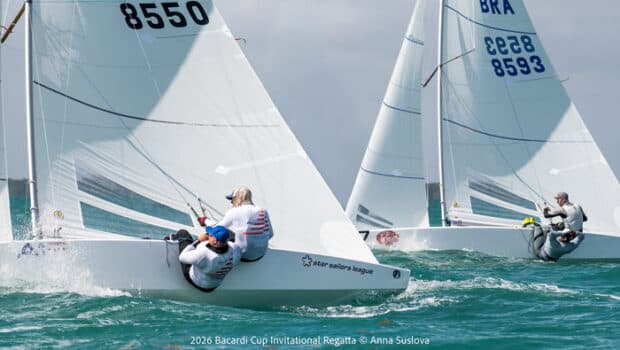
Biscayne Bay hosted 177 boats from 23 countries across five fleets between March 2–7, 2026, requiring synchronized launch schedules, transient mooring assignments and race-committee coordination to stage daily starts for the Star class alongside J/70, Melges 24, Snipe and VX One classes.
Decisive moments on the final day
After a tight five-day series, Paul Cayard (USA) and crew Frithjof Kleen secured the 99th Bacardi Cup outright, finishing with 11 net points to beat Robert Scheidt and Austin Sperry (BRA) by a single point. The regatta climaxed in a high-stakes final race where pre-start match racing and aggressive coverage shaped the outcome: Cayard entered the last race with a three-point lead and deliberately restricted Scheidt through persistent match tactics before the gun.
Both teams suffered deep starts behind the main fleet after an intense pre-start duel. Cayard steered right-hand lanes while much of the fleet went left, a tactical split that left Cayard rounding the windward mark around 26th and Scheidt around 30th—positions that, given the overall scoreboard math, effectively handed control of the title to the leader.
📚 Vous aimerez peut-être aussi
Scheidt staged a remarkable comeback, charging through the fleet to finish 10th in the final race, but it was insufficient to overturn Cayard’s margin. The final exchange demonstrated how match tactics, starting-line positioning and fleet routing can be decisive in an elite one-design regatta.
Podium and top finishers
| Place | Skipper / Crew | Nation | Points |
|---|---|---|---|
| 1 | Paul Cayard / Frithjof Kleen | USA | 11 |
| 2 | Robert Scheidt / Austin Sperry | BRA | 12 |
| 3 | Mateusz Kusznierewicz / Bruno Prada | POL | 16 |
| 4 | Diego Negri / Sergio Lambertenghi | ITA | 23 |
| 5 | Eric Doyle / Payson Infelise | USA | 30 |
Fleet performance and conditions
Racing across Biscayne Bay unfolded in near-ideal spring conditions: consistent easterly breezes in the mid-teens (about 15–18 knots), warm temperatures and steady seas that allowed race committees to run full schedules. The VX One fleet enjoyed sustained advantage in these conditions; Chris Alexander’s VX One team won eight of 11 races to claim their fifth Bacardi title in that class.
- Star class: One race per day March 2–7, culminating in the final showdown between Cayard and Scheidt.
- Other classes: J/70, Melges 24, Snipe and VX One raced March 5–7, increasing launch and recovery pressure on shore facilities.
- Race management: Synchronized starting sequences and division-specific courses minimized on-water congestion despite simultaneous classes.
Notable team dynamics
Winners emphasized chemistry and consistency. Kleen highlighted that strong crew dynamics and predictable boat handling were decisive: when their team sailed at peak performance they were difficult to catch. In Melges 24, Cuyler Morris’s Dark Horse team credited a year of steady crew work and cohesion for their result. The J/70 victory for John Heaton’s Empeiria was similarly built on consistency and risk management.
Historical context: Bacardi Cup and the Star class
The Bacardi Cup dates back to the early 20th century and has evolved into one of the most traditional regattas on the international circuit. As the 99th edition, the 2026 event continued the Cup’s long-running tradition of attracting elite one-design fleets, Olympic medalists and world champions. The Star class itself has been recognized historically as a benchmark one-design keelboat for tactical match racing and fleet racing, with a community that places high value on legacy, craft and intergenerational rivalry.
Paul Cayard’s victory ended a 45-year quest to claim this particular trophy, adding a narrative arc to a storied career that already includes a 2025 Star World Championship title. For many competitors, the Bacardi Cup sits alongside national championships and world events as a measure of sustained excellence in the class.
Operational and tourism implications
Large international regattas like the Bacardi Cup generate measurable impacts on local marine infrastructure and tourism logistics. Key operational pressures observed in Miami included:
- Transient mooring demand: Hosting 177 boats required advanced reservation and staging plans for berthing, cranes and launch windows.
- Transportation and accommodation: Crews, shore teams and event staff strained peak-period hotel capacity and local transport routes.
- Marina services: Increased demand for fuel, provisioning, sail repairs and technical support highlighted the need for robust shore-side vendors during major regattas.
For charter operators and marina managers, such events underscore opportunities: transient yacht charters, day-sailing activities for spectators, and targeted services (captains, boat handling instruction, and guided race viewing cruises) can all be marketed around high-profile regattas to capture boating tourists.
Practical lessons for boating businesses
Charting the overlap between competitive sailing and commercial boating suggests several practical actions:
- Coordinate with race organizers early to schedule berth availability and charter windows.
- Offer specialized packages—race viewing cruises, corporate hospitality on yachts, and on-shore hospitality—to attract non-sailing visitors.
- Maintain quick-response technical teams for last-minute repairs and provisioning to support visiting crews and rented vessels.
Outlook for sailing tourism and international regattas
High-profile one-design events continue to be strong drivers of yachting tourism. As cities and marinas compete to host regattas, investments in marinas, clearwater public beaches and logistics capacity will determine destination competitiveness. Expectations are that star-class and mixed-fleet regattas will keep stimulating transient berth demand, charter activity and related hospitality services, particularly in warm-weather venues along the sea and gulf coasts.
In summary, the 2026 Bacardi Cup combined classic Star class rivalry with high participation and near-ideal sailing conditions, producing a memorable finish as Paul Cayard and Frithjof Kleen clinched a long-sought victory. The event showcased how fleet management, starting tactics and shore logistics converge to shape outcomes—and how such regattas can spur charter demand, bolster marina activity and attract sailing tourists.
For those interested in yachts, charter options, boat hire or planning a sailing trip to similar destinations, GetBoat.com is an international marketplace for renting sailing boats and yachts, likely the best service to find a boat to rent that suits every taste and budget. The Bacardi Cup underlines how events like this drive demand for yacht charters, day-boat rentals, captain-led trips and superyacht hospitality, influencing local marine sale and rental markets, marinas, water activities, fishing excursions and broader yachting destinations. Whether seeking a competitive sailing experience, a chartered cruise on a sunseeker, or a relaxed day on the water near the beach or gulf, the regatta’s ripple effects support a wide range of boating and tourism opportunities.


