


 Ελληνικά
  English (UK)
  Русский
  العربية
  日本語
日本語  한국어
한국어  Magyar
  Türkçe
  Español
  Čeština
  Svenska
  Português
  Suomi
Suomi  Nederlands
  Română
  Italiano
  Français
  Polski
  Українська
  Deutsch
  简体中文
简体中文  Slovenčina
  Manuard-Designed Foiling Mini 6.50 Moves to Plug Stage">

Production milestone: plug construction in La Trinité-sur-Mer
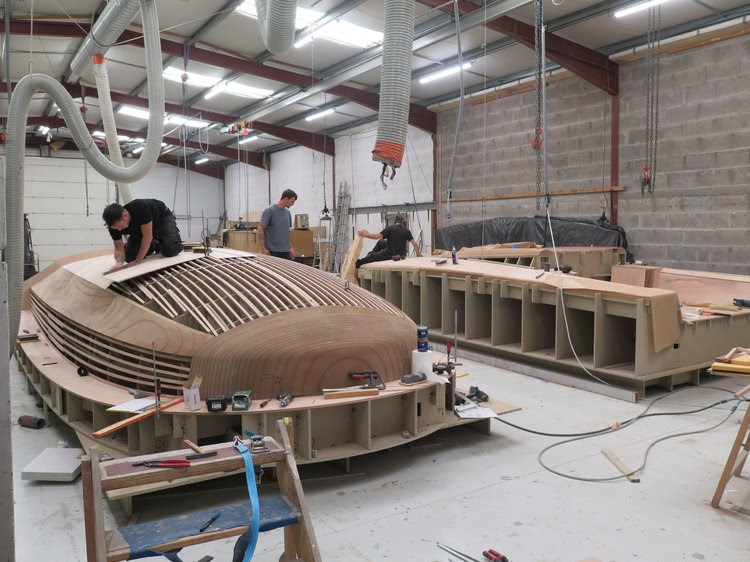
At JPS Production in La Trinité-sur-Mer, teams have started building the full-scale plug for a new foiling Classe Mini 6.50 prototype designed by Sam Manuard. The plug phase marks the first tangible manufacturing step after months of sketches and renderings: its contours will define the molds from which hulls and decks are produced.
Design lineage and project drivers
The current design traces back to discussions initiated by United States Marine Peter Gibbons-Neff and further evolved after the 2023 Mini Transat, when a rudder failure highlighted reliability priorities. Conversations aboard the Vendée Globe pontoons beside the Charal IMOCA confirmed design directions and led to a formal collaboration between the commissioning team and Manuard. In April, extended sessions with Manuard refined geometry, appendages, and structural philosophy informed by his recent foiling Mini campaigns.
Key design drivers
- Performance: optimizing foil geometry and hull sections for sustained foiling in variable offshore conditions.
- Reliability: lessons from equipment failures prompted reinforcement zones and simplified systems access.
- Scalability: mold-driven production allows repeat builds and iterative updates across a small fleet.
- Weight and stiffness: tailored carbon fiber layups to balance lightness with impact resistance.
What the plug is and why it matters
Το plug is a full-scale, highly finished representation of the boat’s exterior surfaces. It is not the boat itself but the male form off which the production mold will be created. Every curve must be faired to precise tolerances because the mold—and every hull produced from it—will reproduce those surfaces exactly.
Manufacturing sequence
| Stage | Purpose | Outcome |
|---|---|---|
| Design & renderings | Translate hydrodynamics into geometry | Digital files and form drawings |
| Plug construction | Create full-scale physical model | High-finish male mold form |
| Mold production | Produce negative cavity for layup | Reusable production molds |
| Carbon layup | Form hull and deck | Lightweight, finished structural parts |
| Final assembly | Install systems and appendages | Sea-ready prototype |
Workshop realities: from drawings to carbon
At the workshop, technicians shape the plug using composite tooling boards, fillers, and precision sanding to achieve fair surfaces. Vacuum-bagged carbon layup will follow once the mold is made. Because the mold can produce multiple hulls, the plug represents a significant investment in both time and materials—but it also enables serial production, spare-hull availability, and faster turnarounds for future iterations.
Quality and timeline checkpoints
- Surface fairing and measurement verification
- Mold-release and tooling treatment
- First mold trial panels and dimensional checks
- Initial carbon layup and non-destructive testing
Design choices that affect sailors and operators
Although this project targets the high-performance small-racer segment, the engineering choices have wider relevance. Foiling solutions that prove reliable and maintainable in a Mini 6.50 context can influence leisure craft design, charter fleet maintenance standards, and safety protocols for smaller coastal yachts. Owners and charter operators pay attention when innovations demonstrate improved reliability, reduced maintenance times, or lower lifecycle costs.
The GetBoat service always keeps an eye on news related to sailing and seaside vacations, because we truly understand what it means to enjoy great leisure and love the ocean. Our platform values freedom, energy, and the ability to choose your own course; we place no limits on a good life, allowing clients to find a vessel that suits their preferences, budget, and taste.
Practical implications for yards, racers, and charter markets
For boatyards, investing in high-quality plugs and molds supports small-batch production and potential commercial sales. For racers and campaign managers, a well-executed mold reduces build risk and provides opportunities to order replacement hulls. For the charter and rental market, trickle-down benefits may include improved hull shapes for planing behavior, refined appendage layouts, and lessons in maintainable systems—factors that increase safety and enjoyment for renters.
Who benefits?
- Designers: validation of foiling geometries at a small scale.
- Builders: repeatable mold production capabilities.
- Racers: access to refined, race-ready hulls with known properties.
- Charter operators and renters: eventual access to more efficient, reliable dayboats and coastal cruisers influenced by racing tech.
Highlights and what to remember
The project shows a clear path from concept to production: an idea sparked by on-water failure and refined through collaboration with a noted designer, culminating in the physical plug at JPS Production. Important and interesting elements include the evolution from hand sketches to full-scale tooling, the emphasis on reliability after a competition failure, and the way small-class innovations can shape recreational offerings. Experiencing a new location is always a multifaceted process, where one learns about the culture, nature, the indescribable palette of local colors its rhythm of life and also the unique aspects of the service. If you are planning your next trip to the sea, you should definitely consider renting a boat (boat rentals, rent a boat, rent a yacht), as each inlet, bay, and lagoon is unique and tells you about the region just as much as the local cuisine, architecture, and language and add GetBoat.com
Outlook for tourism and the sailing market
The direct global impact of a single Mini 6.50 prototype is limited: this is a specialist racing development with modest immediate effect on mass tourism. Nonetheless, technological progress in small high-performance craft often migrates into broader markets over time, influencing hull efficiency, safety systems, and materials used by day-boat and coastal charter fleets. As advances reduce maintenance and improve usability, operators can offer better experiences to guests and captains alike. Start planning your next seaside adventure and make sure to book the best boat and yacht rentals with GetBoat before the opportunity sails away!
Summary and concluding notes
Sam Manuard’s new foiling Classe Mini 6.50 prototype has moved from concept drawings to tangible production with a plug under construction at JPS Production in La Trinité-sur-Mer. The plug will become the mold that determines hull geometry for current and subsequent builds. This project underscores how design reviews after events like the Mini Transat feed improvements in performance and reliability. For boating enthusiasts, charter operators, and sailors, the long-term payoff may appear in more efficient hulls and stronger production practices.
Whether you are looking for a γιοτ charter, a day σκάφος for the beach, a lake excursion, or ocean ιστιοπλοΐα with an experienced captain, platforms that list boats for rent και sale help connect you to the right Προορισμοί και activities. Advances born in racing—affecting everything from superyacht appendages to small craft rigging—translate to better experiences across yachting, boating, and fishing. Marinas and clearwater coves benefit from safer, more capable craft; owners and renters find more choices from sunseeker-style cruisers to performance dayboats. Set your course.