How a Custom Catamaran Rewrote Stability Rules
Alexandra
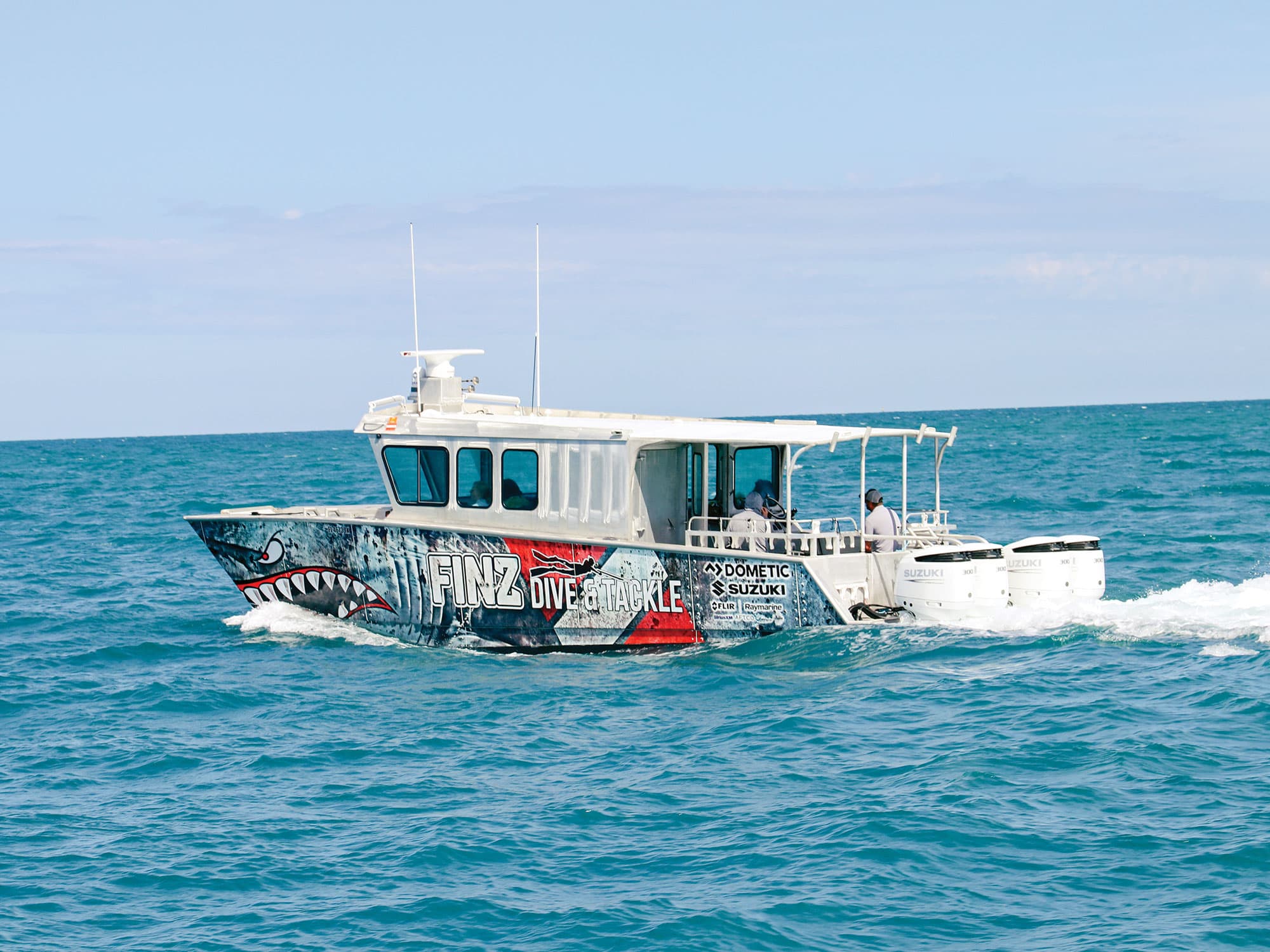
The 140-mile round trip from Key West to Dry Tortugas National Park forces operators to prioritize sustained cruise speed, payload for diving gear, and reliable electrical systems to run air conditioning and avionics — all while returning passengers to Key West the same evening.
Hull, powertrain and payload: the logistics of a dive run
The 35-foot aluminum catamaran Park Shark, built by Razorhead for Capt. Robert Trosset of Finz Dive & Tackle, was laid out to solve a compact set of operational constraints: carry six passengers in air-conditioned comfort, store 28 SCUBA tanks, provide a full stand‑up head, and deploy a front ramp for beach-style landings at Fort Jefferson — all while making the 70‑plus‑mile one‑way run reliably and quickly. Propulsion comes from quad Suzuki 350 outboards to meet transit-time targets and provide meaningful reserve thrust when currents and winds increase fuel burn.
Design decisions driven by operational needs
The boat’s equipment plan purposely removes the typical onboard generator to avoid extra weight, maintenance and carbon‑monoxide risks. Instead, Park Shark relies on a robust LiFePO4 battery bank to power HVAC, refrigeration and stabilization gear — a setup that directly affects turnaround time, maintenance scheduling and charter availability for day trips.
📚 Das könnte Sie auch interessieren
Must-have features for a dive charter workboat
- Large interior cabin: shelter for brief shore excursions and bad weather.
- High SCUBA capacity: rack storage for long dive groups.
- Ramp for shore operations: landing craft-style access.
- Fast cruise speed: minimize transit to maximize time at destination.
- Quiet, reliable power: LiFePO4 bank instead of a generator.
Gyro stabilization off the centerline — a practical experiment
When Dometic launched the DG3 gyrostabilizer, its compact footprint, faster spin‑up and power-generation capability made it an attractive option for a multi-role charter boat. The DG3 reaches full operating rpm in about 16 minutes versus an industry average of 50 minutes, and it spins down in under 20 minutes instead of the more typical multi‑hour cooldown. That shorter spin cycle and the unit’s ability to generate a portion of its own electrical needs reduced several logistical barriers to installing a gyro on a small power cat.
| Parameter | DG3 (Park Shark) | Industry Avg. |
|---|---|---|
| Spin‑up time | ~16 minutes | ~50 minutes |
| Spin‑down time | <20 minutes | ~8 hours |
| Electrical savings | ~40% reduction | — |
| Roll reduction (real world) | 85–87% | Varies |
| Typical install footprint | Compact | Larger |
Off‑center installation and weight balancing
Because Park Shark carries a large forward cabin and specific hull structure, the DG3 was installed in the starboard hull rather than the centerline. To address the eccentric mass, batteries, power management and water/holding tanks were positioned on the port side, balancing roughly 600 pounds of gyro hardware. Engineers from Dometic advised Razorhead on structural reinforcement to distribute stress loads — an example of coordination between system supplier and builder that charter operators can learn from when planning retrofits.
Performance gains and operational benefits
Despite the unconventional mount, long‑term testing on the 23,000‑pound finished boat showed an actual roll reduction in the mid‑80s percentage range. For charter and rental operators, that translates into tangible guest comfort improvements while drifting or anchoring in beam seas, fewer aborted trips due to passenger discomfort, and more efficient wave entry/exit behavior during long runs. In plain speak: the boat lands flatter, the ride is softer, and fuel use improves on transit.
Retrofit considerations for rental fleets
- Confirm installation space and structural support under the leaning post or other furniture.
- Plan for weight redistribution (batteries, tanks) to maintain trim.
- Validate electrical capacity and LiFePO4 integration for sustained gyro operation.
- Coordinate with original builder or a naval architect for stress‑load analysis.
According to Steve Watson, Dometic Product Manager, similar benefits are achievable on cats up to about 34 feet with a single DG3, and larger platforms can use two units — provided installation space and structure are addressed. That makes gyro stabilization a realistic upgrade path for many charter, dive and rental operators looking to differentiate their experiences.
In short, the Park Shark build shows that clever integration — from quad Suzuki 350 propulsion to a compact DG3 gyrostabilizer and a LiFePO4 power backbone — can transform a workboat into a comfortable, efficient day‑trip platform. For anyone running a charter, rental or dive operation, the lesson is clear: investing in the right stabilization and power architecture reduces downtime, improves guest comfort and broadens possible destinations without sacrificing payload. Whether you manage a yacht or an entry-level boat for rent at the marina, these changes ripple into better passenger experiences at the beach, lake or open sea — more satisfied captains, longer seasons for boating and stronger sales for charter activities, fishing trips and yachting excursions.


