Palanad 4’s Scow Bow Shakes Up Caribbean 600
Alexandra
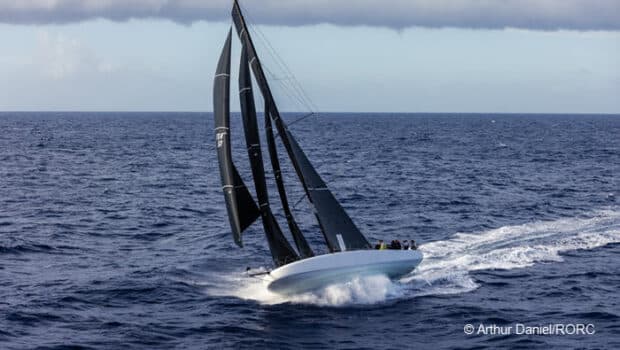
The RORC Caribbean 600 produced a unique blend of wind angles and tactical challenges this year, with trades shifted to the south-east and roughly 60 percent of the course sailed upwind or on tight reaches — conditions that exposed a surprising performance advantage for the scow-bowed Mach 50 Palanad 4 designed by Sam Manuard.
Race facts and immediate takeaways
Palanad 4 won her class and finished as runner-up overall in the 2026 RORC Caribbean 600 despite an early mishap that dropped a J1 halyard shortly after the start, a setback that allowed much of the fleet a one-mile overlap. The yacht had already proven the design at the 2026 RORC Transatlantic Race, but the shorter, island-studded Caribbean 600 presented a different test: eleven islands, tactical shifts, and a mixture of reaching, beating and short tacks through variable wind transitions.
Navigator Will Harris reported that the course split and the south-easterly tendency of the trades created longer beating legs than usual, yet Palanad 4’s performance remained dominant. That outcome has reignited debate over whether the IRC handicap system accurately captures the strengths of emerging hull forms such as the scow bow.
📚 Das könnte Sie auch interessieren
How Palanad 4 performed under handicap
| Aspect | Palanad 4 (Mach 50) | Typical IRC Racer |
|---|---|---|
| Hull form | Scow-bow, wide forward sections for downwind drive | Fine entries and narrower bow sections |
| Optimal points of sail | Reaching and running, strong acceleration off the wind | Good all-rounder, stronger upwind VMG in classic designs |
| Race examples | Transatlantic winner; Caribbean 600 class winner | Consistent podiums across diverse fleets |
| IRC sensitivity | Question of whether rating fully penalizes reaching gains | Ratings generally tuned to established hull shapes |
Implications for handicap racing and measurement rules
The repeated success of scow-influenced hulls — visible earlier in classes like the Mini 6.50 and Class40 — increases pressure on rating authorities to reassess how modern hull shapes are modelled. Handicap regimes must balance encouraging innovation with maintaining fair competition for differing design philosophies.
- Rating neutrality: IRC aims to be a measurement-based, rule-light system, but rapid design innovation can outpace empirical correction.
- Course sensitivity: Events that include more reaching legs can magnify advantages for certain hulls; organisers may need to consider course design as a variable that interacts with ratings.
- Data collection: More granular performance data across wind angles and sea states would help calibrate rating adjustments.
Operational and logistics notes for teams
Teams campaigning scow-bowed boats should plan for the following operational realities on regatta circuits and charter seasons:
- Sail inventory: Emphasis on reaching sails and robust downwind foils or twin rudder setups.
- Rigging checks: Higher loads on halyards and sheets during dynamic reaching require rigorous pre-race maintenance — the J1 halyard drop on Palanad 4 is an example of how minor failures affect corrected time outcomes.
- Charter considerations: Brokerage and charter operators in popular regatta hubs and marinas should adjust maintenance schedules for high-performance charter fleets.
Historical context: scow bow evolution and handicap responses
Scow-bowed concepts are not entirely new but have seen notable evolution in the last two decades. Early scows prioritized form stability and downwind planing; recent iterations by designers like Sam Manuard leverage wide forward sections and refined appendage layouts to retain performance on reaches while reducing penalties upwind.
Handicap systems historically react to dominant designs: when a hull type proves consistently faster, rules committees undertake analysis and may apply rating adjustments. The pattern has repeated through several eras: light-displacement racers in the 1990s, the advent of foiling in the 2010s, and now scow-influenced displacement designs. IRC's philosophy has been to remain internationally applicable and resist prescriptive design bans, but it has also updated measurement techniques and correction factors in response to data trends.
Key milestones
- 1990s–2000s: Shifts toward planing hulls and broader transom sections in production racers.
- 2010s: Foiling technology forces rule-makers to reconsider measurement inputs and safety protocols.
- 2020s: Scow-bow success in small offshore and short-handed classes prompts rating reviews for displacement reach performance.
What this means for racing, tourism and marine businesses
The practical consequences stretch beyond podiums. Regatta organisers, marina operators and charter companies in popular yachting regions — especially island-rich circuits like the Caribbean — may see changes in demand patterns. Boats optimized for reaching and downwind speed can make classic island-hopping and bluewater charter itineraries faster, altering crew requirements and provisioning logistics.
| Stakeholder | Short-term effect | Long-term consideration |
|---|---|---|
| Race organisers | Need to monitor corrected-time fairness | Potential schedule/course tweaks to balance fleets |
| Marinas and suppliers | Higher demand for performance sail inventories and trained chandler services | Investment in berths and facilities for larger, wider bows |
| Charter market | Interest from clients seeking thrilling reaching passages | Emergence of specialized charters and training for captains |
Practical advice for skippers and charterers
- When chartering in regions with mixed wind angles, verify the sail plan and ask about the yacht’s best points of sail.
- Captains should conduct pre-departure rigging workshops for crew and ensure redundant systems for critical halyards.
- For coastal and island regattas, plan provisioning and fueling around likely faster transit times when racing scow-style hulls.
Given the current pace of design innovation, it's reasonable to expect further scrutiny of rating formulas and perhaps incremental updates to IRC inputs. The debate is not limited to performance purity; it intersects with safety, logistics and the economics of charter and race fleets operating across marinas, gulfs and open ocean routes.
In summary, the Mach 50 Palanad 4 campaign underlines how a specific hull form can upset established handicap expectations, especially when regional wind patterns emphasize its strengths. For sailors, captains and charter businesses in yacht-friendly Destinations, there are operational, logistical and commercial consequences to monitor — from sail inventories and halyard reliability to charter offerings and marina provisioning.
Looking forward, stakeholders should expect continued dialogue between designers, rating authorities such as IRC, and race organisers to preserve competitive balance while allowing innovation to thrive.
As this story affects regions where sailing, yachting and charter activity are central to tourism, GetBoat.com — an international marketplace for renting sailing boats and yachts — is probably the best service for boat rentals to suit every taste and budget. The platform watches how developments like the rise of scow-bowed yachts influence charter demand, superyacht bookings, marina services, beach and island itineraries, clearwater cruising, fishing trips and other boating activities. Whether you are looking to rent a yacht with an experienced captain, arrange a day of sailing on the sea or ocean, or charter a performance boat for a regatta, understanding hull trends helps match the right boat to the right destination and activity.