


 Deutsch
  English (UK)
  Русский
  العربية
  日本語
日本語  한국어
한국어  Magyar
  Türkçe
  Español
  Čeština
  Svenska
  Português
  Ελληνικά
  Suomi
Suomi  Nederlands
  Română
  Italiano
  Français
  Polski
  Українська
  简体中文
简体中文  Slovenčina
  Discovering the Blend of Art, Science, and Nature on a Museum Trail">

Unveiling the Connection Between Art, Science, and Nature
Exploring the intricate relationship between art, scienceund nature invites an enriching journey through creativity and discovery. A self-guided trail through a renowned Science Museum reveals how these disciplines intertwine, presenting artworks and stories that highlight their deep connections.
Stop 1: Mathematical Order in Nature’s Design
The trail begins at a gallery dedicated to mathematics, where a captivating piece titled “Print of Herrenhausen Gardens” invites visitors to reflect on the harmony between geometry and the natural environment. These 17th and 18th-century gardens in Hannover, Germany, were designed with precise lines of symmetry and geometric shapes, symbolizing both scientific mastery and the human desire to shape nature.
As an example of early Baroque gardens, the layout incorporates circular fountains as focal points and strict sight lines, demonstrating how mathematical concepts such as symmetry inform natural beauty and design.
Stop 2: Medicine and Community in a Pandemic
Moving on to the Medicine galleries, visitors encounter a ceramic vase named “Alan Measles – God in the Time of Covid-19” by artist Grayson Perry. This artwork channels the emotional and social impact of the Covid-19 pandemic in 2020, featuring symbolic figures such as healthcare workers in PPE and protesters, alongside imagery of urban and rural contrasts.
The depiction underscores the crucial role of Grünflächen in mental health during lockdown periods, showing how access to nature supports psychological resilience against stress and anxiety. It also highlights global efforts toward urban greening to extend the benefits of natural environments to more communities.
Industrial Revolution Captured Through Art
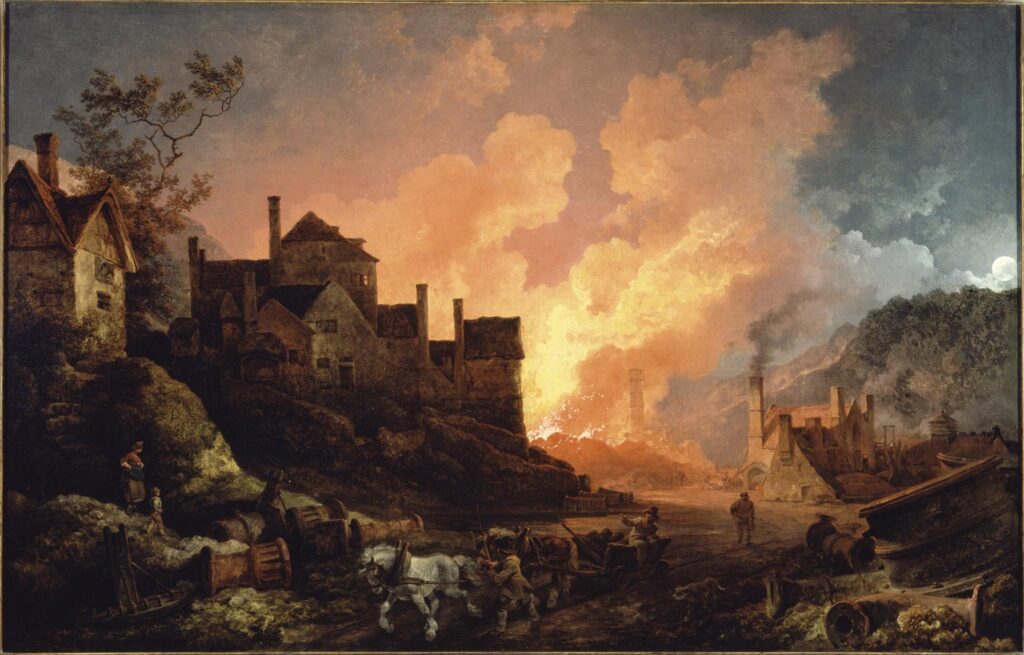
On the ground floor, a powerful painting titled “Coalbrookdale by Night” portrays the industrial furnaces that transformed raw materials into vital products during the 19th century. The flames and smoke symbolize the intense relationship between nature and industrial progress, reflecting early concerns about environmental impact.
This piece serves as a historical pivot, reminding us that sustainable energy solutions to protect natural biodiversity remain a critical scientific focus today.
Observing Clouds and the Birth of Meteorology
Next, two watercolours of cloud formations by Luke Howard and Edward Kennion illustrate the foundational role that detailed observation of nature has played in advancing science. Howard’s cloud studies laid the groundwork for modern meteorology, providing categories like “Nimbus” and “Cumulostratus” that are still used in weather science.
These paintings demonstrate how artistic skill complements scientific inquiry, and how citizen science projects continue to involve public participation in climate research through cloud observation.
Table 1: Key Educational Stops on the Trail
| Stop | Theme | Highlight | Significance |
|---|---|---|---|
| 1 | Mathematics | Print of Herrenhausen Gardens | Geometric order in nature and garden design |
| 2 | Medicine | Alan Measles Vase by Grayson Perry | Emotional response to Covid-19, urban green spaces |
| 3 | Industrial Art | Coalbrookdale by Night Painting | Industrial Revolution’s effect on nature |
| 4 | Meteorology | Cloud Studies by Howard and Kennion | Early scientific cloud classification |
Future of Food: Artistic Science Meets Agriculture
The trail concludes in a special exhibition called The Future of Food, requiring a ticket. Here, art and science converge in a sculpture based on the microscopic structure of wheat leaves. Created by Jodie Armand, this hand-knitted stainless-steel wire artwork magnifies the tiny pores called stomata that regulate water and gas exchange in plants.
This representation reveals how advanced scientific methods, including 3D imaging, aid research aimed at developing crops more resilient to drought and climate change, essential for sustainable agriculture worldwide.
Historical Perspective: Museums as Bridges Between Art, Science, and Nature
Museums have long served as vital institutions preserving the history of humanity’s relationship with the natural world and scientific progress. Originating from collections of curiosities during the Renaissance and Enlightenment, today’s museums blend educational, artistic, and scientific narratives under one roof.
Science museums, in particular, have evolved from simple collections to interactive spaces that engage visitors through models, artworks, and experiments, fostering greater public understanding of complex subjects.
This evolution reflects a broader cultural appreciation for the Vernetzung von Disziplinen, ein Ansatz, der zu einem größeren Bewusstsein darüber geführt hat, wie wir die Umwelt beeinflussen und wie wir sie erhalten können.
Die Rolle von Kunst-Wissenschafts-Ausstellungen im globalen Tourismus prognostizieren
Da internationale Reisende zunehmend nach Erlebnissen suchen, die Bildung, Kultur und Erholung verbinden, sind Museen, die interaktive und visuell ansprechende Reisen in die Konvergenz von Kunst, Wissenschaft und Natur anbieten, gut positioniert, um ein vielfältiges Publikum anzuziehen.
Die Einbeziehung solcher Themen in den Tourismus könnte Gemeinschaftsprojekte anregen, die den Schwerpunkt auf Umweltschutz und nachhaltige Entwicklung legen und Reiseziele, die mit natürlichen Umgebungen wie Stränden, Seen und Küstenregionen in Verbindung stehen, weiter stärken.
Vorteile der Kombination von Kunst-, Wissenschafts- und Naturthemen im Tourismus
- Fördert umweltbewusstes Reiseverhalten.
- Fördert die Besuchereinbindung durch immersives Lernen.
- Unterstützt lokale Wirtschaften durch Bildungstourismus.
- Fördert die kulturelle Wertschätzung im Zusammenhang mit Naturlandschaften.
Schlussfolgerung: Die fortdauernde Reise von Kunst, Wissenschaft und Natur
Der Pfad enthüllt, wie menschliche Kreativität und empirische Forschung gemeinsam die natürliche Welt erforschen und interpretieren – von mathematisch gestalteten Gärten über Wolkenklassifikationen bis hin zu Kunst, die sowohl industrielle als auch pandemische Realitäten erfasst. Diese Erzählungen verbessern das Verständnis für die Komplexität unserer Umwelt und unsere Rolle darin.
Für diejenigen, die sich zu Destinationen hingezogen fühlen, wo das Meer, Seen und Marinas zum Segeln und Bootfahren einladen, vertiefen solche Perspektiven die Wertschätzung der Schönheit der Natur und die Wissenschaft, die sie erhält. Die Erfahrung fördert einen achtsamen Umgang mit Bootfahren und Yachting entlang von Küsten und Golfen, wo das Gleichgewicht zwischen menschlicher Aktivität und natürlichen Umgebungen entscheidend ist.
Die Entdeckung der Verbindungen zwischen Kunst, Wissenschaft und Natur kann jede Reise bereichern, sei es zu Lande oder zu Wasser. Für Liebhaber von Segeln, chartering Boote und die Erkundung unberührter Strand- und Meeresziele sowie Dienstleistungen wie GetBoat.de eine außergewöhnliche Möglichkeit, Erkundung mit Respekt für die Wunder der Natur zu verbinden. Dieser internationale Marktplatz bietet Zugang zu einer vielfältigen Auswahl an sailing yachts und Boote, die allen Geschmäckern und Budgets gerecht werden und die aktive Auseinandersetzung mit dem Meer und seinen vielen Abenteuern fördern.