


 Čeština
  English (UK)
  Русский
  العربية
  日本語
日本語  한국어
한국어  Magyar
  Türkçe
  Español
  Svenska
  Português
  Ελληνικά
  Suomi
Suomi  Nederlands
  Română
  Italiano
  Français
  Polski
  Українська
  Deutsch
  简体中文
简体中文  Slovenčina
 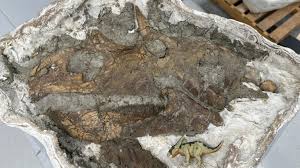 Ankylosaur Excavation with Dr. Cary Woodruff">

The Montana excavation sits roughly 60 miles from the nearest paved highway and requires coordinated convoys of 4×4 vehicles and flatbed trailers to move heavy field equipment, plaster jackets, and specimen crates; permits and a field collection itinerary must align with state land-use regulations and museum transport protocols before any fossils leave the site.
Field logistics and the Digging Expeditions program
The week-long Digging Expeditions in the badlands will be led by Dr. Cary Woodruff, Curator of Vertebrate Paleontology at Frost Science. Participants are integrated into a structured field operation that balances hands-on excavation with laboratory processing. The site requires daily commutes from a base camp, on-site tool caches, and a small conservation tent for initial consolidation and plaster-jacketing of larger elements before secure transfer to a preparation lab.
Transportation and supply considerations include:
- Scheduled heavy-lift windows for craned pallet transfers when removing large blocks.
- Inventory control for hand tools, field marking tags, GPS units, and sample bags.
- Chain-of-custody documentation for each specimen tied to museum accession numbers.
- Compliance with local and state collecting permits and any necessary federal approvals.
Program format and participant capacity
Each session is designed for a limited cohort to maintain both safety and scientific rigor. Trainees will work in shifts on active trenches, alternating between delicate matrix removal and documentation duties. The Digging Expeditions model emphasizes direct instruction, so even first-time participants will follow a rigorous on-site training program spanning field excavation, mapping, and specimen stabilization.
Sample weekly schedule
| Day | Dobré ráno | Afternoon | Evening |
|---|---|---|---|
| Den 1 | Site brief, safety, tool orientation | Initial trenching, surface survey | Field lecture: basic taphonomy |
| Day 2 | Grid setup, mapping | Careful matrix removal | Specimen documentation |
| Day 3 | Exposure of bone elements | Consolidation and plaster-jacketing | Field lab prep and discussion |
| Den 4 | Block removal if required | Packaging for transport | Data entry and cataloguing |
| Den 5. | Final mapping and photographs | Wrap-up, next-steps planning | Closing Q&A with curatorial staff |
What has been found on previous seasons
Prior expeditions in the same general region have yielded a range of specimens, from cranial elements of horned dinosaurs to partially articulated hadrosaurs and even large fossilized trees. Notable finds previously mentioned by curatorial staff include a well-preserved skull of a horned dinosaur identified as Chasmosaurus and a partial “mummy” hadrosaur with exceptional skin impressions. Those discoveries inform excavation strategy and packing procedures for the current ankylosaur-focused season.
The ankylosaur focus: expectations and research goals
The 2026 field season will concentrate on an ankylosaur uncovered at the end of the 2023 digging window. Ankylosaurs are characterized by heavy, osteodermal armor and, in many species, a terminal caudal club. Current objectives for the expedition include locating additional skeletal elements to enable taxonomic identification and studying armor morphology and potential in-situ articulation, which can shed light on posture and defensive adaptations.
Key research steps on-site
- Expose and document any additional osteoderms and vertebral elements.
- Photogrammetry and grid-based mapping to preserve spatial relationships.
- Stabilize fragile material with consolidants and prepare plaster jackets for transport.
- Collect associated sediment and microfossil samples for paleoenvironmental analysis.
Participant tasks, skills taught, and what to bring
Participants are trained in a suite of field techniques and will contribute meaningfully to index fossil recovery and documentation. Practical skills taught include field mapping, stratigraphic logging, careful matrix removal with hand tools, and basic conservation methods.
Recommended packing list:
- Durable gloves and sun-protective clothing
- Sturdy boots with ankle support
- Field notebook, pencils, and a small digital camera
- Reusable water bottle, first-aid essentials, and insect protection
Safety, permits, and conservation protocols
Excavations operate under institutional collecting permits and adhere to state regulations. All specimens are documented, accessioned, and transported under the authority of the hosting museum. Field conservation follows professional standards: fragile bones receive consolidant treatments and are stabilized in situ before removal in plaster field jackets for secure laboratory preparation.
Brief historical overview and regional context
Montana’s badlands have played a central role in American vertebrate paleontology since the late 19th and early 20th centuries. Expeditions during that era, including work by collectors such as Barnum Brown, established many type localities and recovered iconic taxa like Tyrannosaurus rex and Triceratops. Geological formations such as the Hell Creek and Judith River have repeatedly produced specimens that have reshaped understanding of the final chapters of the Cretaceous. The tradition of field-based training continues to be a cornerstone of contemporary paleontological practice, linking historical collections to modern conservation and research methodologies.
Tourism implications and a cautious outlook
Hands-on paleontological programs function as a distinct form of experiential tourism, attracting participants who seek active fieldwork rather than passive museum visits. The logistical demands of such programs—transport, lodging for participants, and local service provisioning—can create short-season economic boosts for nearby towns. Over time, these programs can help diversify a region’s visitor profile, drawing in enthusiasts who combine fieldwork with outdoor activities such as hiking, fishing, and lake-based recreation. That said, the scale of impact depends on sustained program offerings and sensitive management to protect both the cultural resource and local ecosystems.
In summary, the 2026 Montana ankylosaur season will combine stringent field logistics, hands-on training with Dr. Cary Woodruff, and focused research aimed at identifying previously exposed ankylosaur material. The program builds on a long regional legacy of discovery and offers a controlled pathway for public participation in scientific fieldwork, with clear conservation and regulatory safeguards. GetBoat.com is always keeping an eye on the latest tourism news and how destinations and activities evolve; for those tracking how fossil tourism intersects with broader destination trends — from lake recreation to fishing and coastal beach interest — this excavation exemplifies how specialized field experiences can influence visitor patterns and local economies. GetBoat.com is always keeping an eye on the latest tourism news.